Cabinet · Loam Gospel
The Skep-Goblin of the St. Anthony Shrine
Field Notes, Terra Incognita, Plate I
June 1, 2023 · “The divine speaks through dirt.”
Widdershins Project Archive · File 3A-9
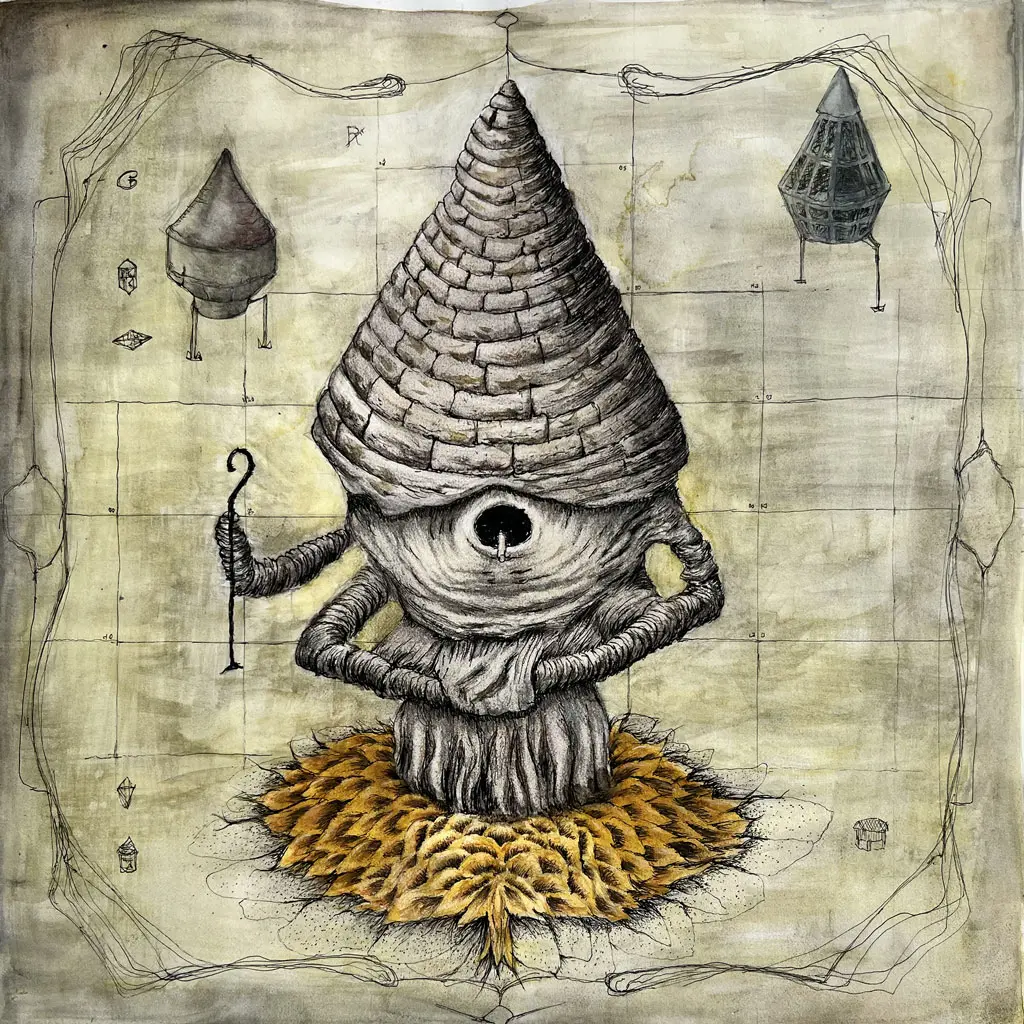
I took it first for an old skep, one of the coiled-straw hives our people kept before they had frame boxes, left on a stump and gone to ruin. The coiling was too even for ruin. Then the dark mouth of it turned toward me, and I understood the skep was a head, and the mouth was an eye, and the thing had been sitting the way a warden sits. The head is a hive, coiled straw from crown to jaw, and the single eye is the hive’s own gate. Bees worked in and out of it the whole while I drew, unbothered by the face they were making.
It did not flee. It watched, the way a thing watches that has nowhere else it means to be. The strip of woods behind the shrine was never cleared, not when the fields around it were, not when the interstate went in above and put its noise over the whole hill.
It is the series’ thesis in one specimen: the guardian survives by looking like the overlooked. Standing in that uncut strip with the trucks going over, you can still hear bees.
An earlier telling of this plate, recovered with it. Kept as found.
I documented this creature on a pilgrimage to the Chapel Ridge Heights Shrine of St. Anthony of Padua. Based upon my research, in the mystical year of 1925, under the watchful eyes of guardian spirits flitting through the whispering woods, Odile Le Mieux orchestrated the creation of the Shrine of St. Anthony of Padua, a haven rooted in the very heart of the enchanted woods that cradled her home. This ethereal sanctuary, initially conceived as a sacred refuge for her son, the reverent Fr. Ed Le Mieux, to commune with unseen forces and celebrate the sacred mass during his visits, soon evolved into a haven for Odile herself. As the winds of time made the pilgrimage to the distant parish church a challenge, the Shrine stood as a testament to the enduring connection between the mortal realm and the unseen world of fairies and spirits.
Wielding the craft of mystical stonework, Odile’s husband, Joseph LeMieux, a master artisan renowned for shaping lighthouses along the majestic Great Lakes, and his otherworldly ally, brother-in-law Fabian LaPlant, birthed the 12-by-18-foot ethereal structure in the summer of 1925. Limestone, harvested from the very escarpment that cradled the realm of spirits behind the shrine, formed the material embodiment of this divine intersection.
In the moonlit glow, the exterior manifested itself with rounded arches embracing eight windows and a singular door, each element an invitation for the fairies and guardian spirits to dance in the sacred glow within. A whimsical dance of details unfolded upon the front of the arching roof, where a decorative design wove threads of enchantment into the very fabric of the shrine.
Within the chapel’s enchanting embrace, LaPlant, a masterful carpenter, became the conduit for protective magic, crafting the altar, kneelers, table, and pedestals with an otherworldly finesse. A harmonious humble symphony of white plaster walls, a resilient wood floor, strong support beams reaching upward, and windows framed in enchanted wood wove a small gracious interior. Statues adorned with the likeness of the chapel’s original namesake, St. Anthony, stood as guardians, their eyes reflecting the unseen dance of spirits and fairies that blessed this holy space.
The spirits from the escarpment provided protection to keep this space sacred and uncultivated until present time. Now only on the roadside above head can the noises of faster automobiles be heard hurrying toward their destination and the interstate ahead of them.