The Ruins of the Midwest
The Second Salvage
black-and-white photographs made at Dr. Evermor's Forevertron, where the camera's oldest promise is kept and corrupted at once
Don Krumpos · 2007
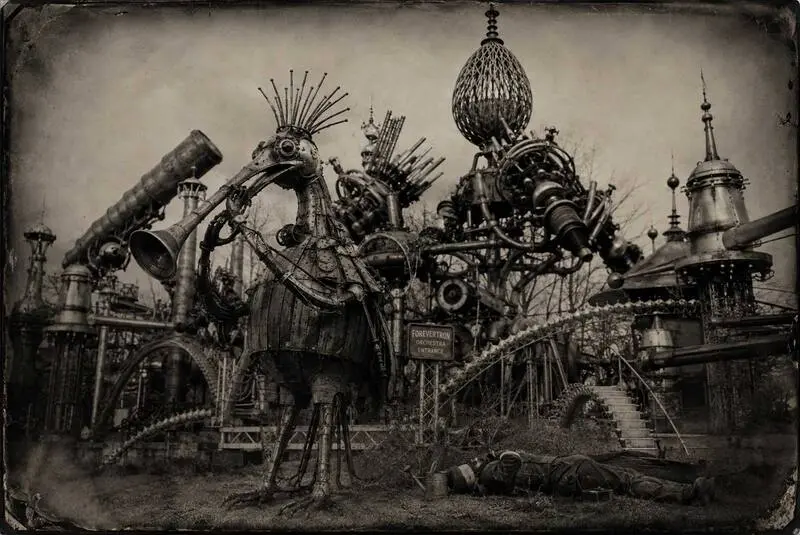
The camera makes a promise no other picture makes. Not that it looks like the world, but that the world once stood in front of it. I went to the Forevertron to break that promise without letting go of it.
A photograph is less a picture than a trace. Light leaves a thing, crosses a lens, and changes an emulsion. The image is caused by its subject and not merely fashioned to resemble it. Peirce calls this kind of sign an index, bound to its referent by physical fact. Bazin believed the camera embalmed time; Barthes ground the whole medium down to one stubborn sentence: that-has-been. Whatever else a photograph does, it testifies. It swears the world was there.
I made these pictures at Dr. Evermor’s Forevertron to put that oath under strain.
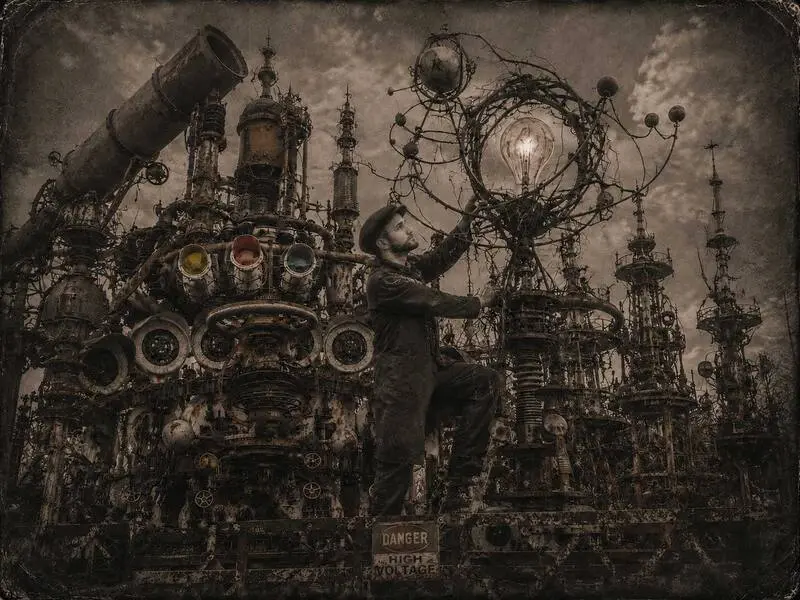
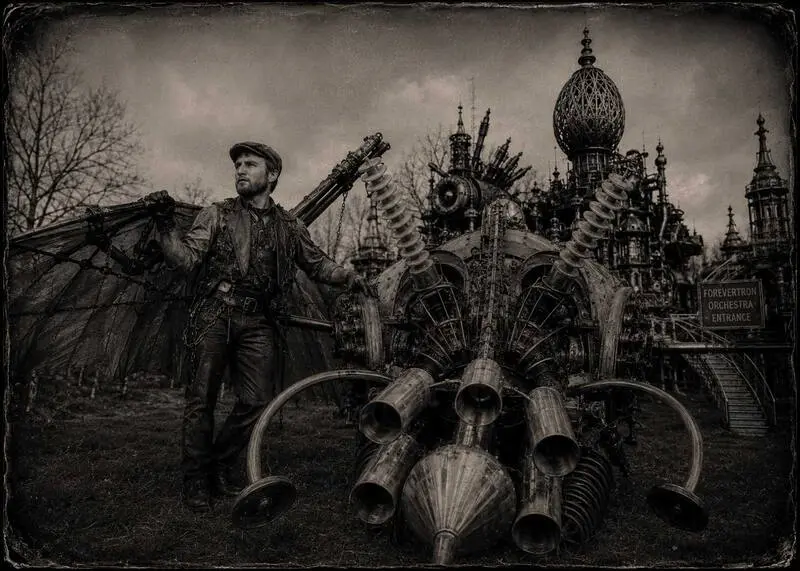
The place strains meaning before I ever raise a camera to it. Evermor gathered up the cast-off nervous system of an industrial century: dynamos and boilers, decontamination chambers, generators pulled from power plants, laboratories, and the space program, and restored none of it. He built the scrap into birds and orchestras and observatories and the engine of his own private cosmology. His method is bricolage in Lévi-Strauss’s sense: building not from purpose-made stock but from whatever lies to hand, each fragment still trailing the ghost of its first job. A dynamo becomes an organ without once ceasing to be a dynamo. The object is cut loose from its function and made to mean something it was never built to mean.
I shoot in black and white because I want the picture to do to the document what Evermor does to the machine.
The method is half the argument. I work the Forevertron with an 8-by-10 camera and dip the negatives by hand. Then I build the frames the way Jerry Uelsmann built his: several negatives married in the darkroom, their seams closed through masking, dodging, and burning until an impossible scene carries the tone of a single exposure. The trick is older than Uelsmann. Méliès discovered that a camera could stop, substitute one reality for another, and begin again, and that we would swallow what it handed us whole. I hold to the darkroom as long as it will hold me. When a seam refuses to close beneath the enlarger, I finish it in Photoshop. I have made my peace with that surrender. The work admits in its own body that the seamless photograph was always built; the tools for building it have merely grown quieter.
The camera is honest about one thing and lies easily about the rest. It confirms that light touched these surfaces. It says nothing about what was true.
So I keep the trace and corrupt the account.
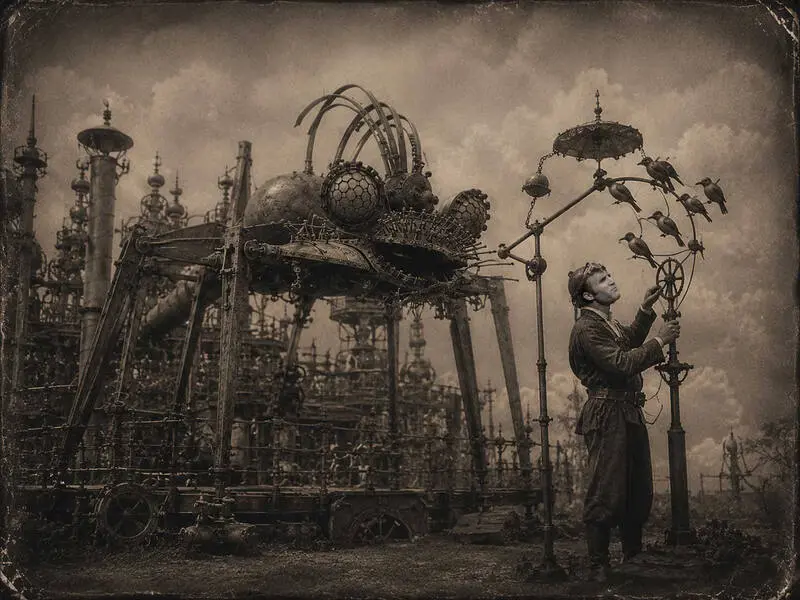
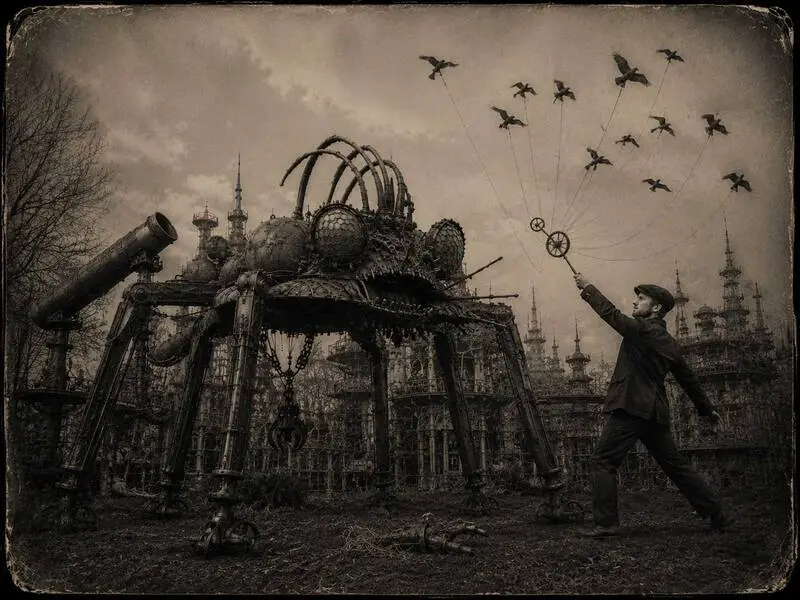
I stage. A tinker walks into the frame who belongs to no record. Long exposures give iron the blur of breath. A man leans back and flies a flock of birds on strings from a hand-wheel, worked for a purpose no one can name. Objects that genuinely stood at the site appear in arrangements that never happened there. The finished photograph is assembled from genuine traces of the world into an event the world never contained. Its pieces testify. Their testimony has been made to lie.
This is the same operation Evermor performs on the machine. He salvages objects whose material histories remain real while their meanings are reassigned. I salvage photographic traces whose referents remain real while their event is invented. The Forevertron is a bricolage of industrial artifacts; the photograph becomes a bricolage of indexes. Neither erases what came before. The old meaning remains lodged inside the new one like a ghost.
That gap is the whole subject.
Photography promises this was there. My pictures can promise only something like this was there, which is the promise memory makes too. To remember is not to retrieve but to rebuild: a reconstruction from fragments in which fact and later invention fuse until the seam is lost. The archive was meant to be the cure for that, the incorruptible witness set against a failing mind. I am after the photograph that has caught the very disease it was built to prevent.
Which is where the title comes from.
To restore an object is to walk it back toward its origin and its truth. To salvage it is to take what remains, freed of that debt, as stock for something new. Evermor performs the first salvage, lifting dead machines out of their industrial afterlife while leaving their material histories visible. I perform the second. I take photographic traces of his already-salvaged world and assemble them into events that never occurred.
The metal is real. Its machine is gone.
The light is real. Its event is invented.
Nothing here has been restored.
Everything has been salvaged.