The Ruins of the Midwest
A Machine for Not Hearing
a sensory deprivation chamber welded from the farm's horse trough
Don Krumpos · Fall 2006
The statement that hung on the door of the sculpture shop, 2006:
My father is going to sell the farm I grew up on. Before its contents are hauled off or sold for scrap, I am going through them and making work out of what is there.
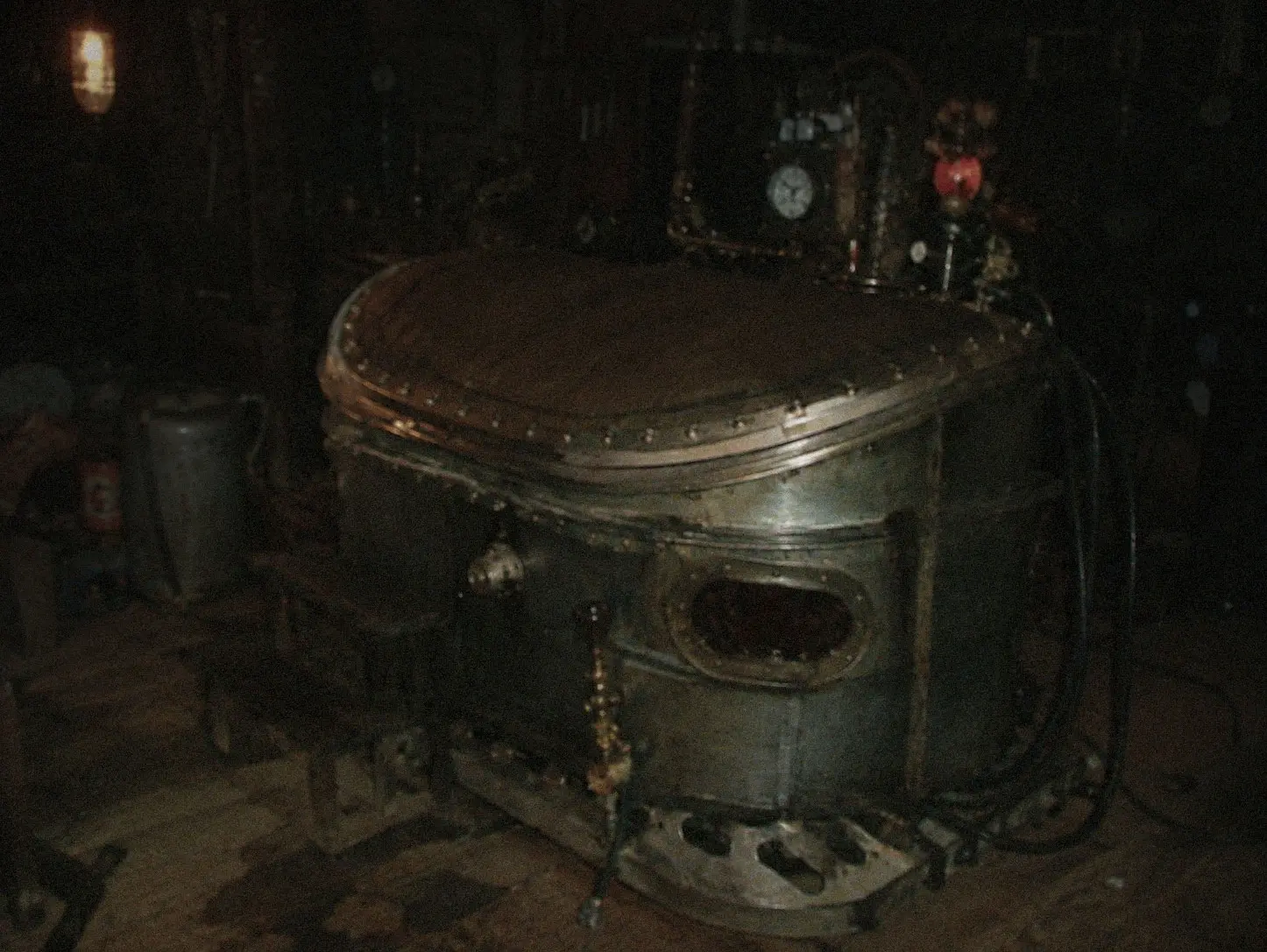
The tank on the skids is a sensory deprivation chamber. I welded it from the old horse trough my sister and I used to swim in to cool off on the hottest days of summer. It is full of salt now so a body floats, and a fan runs somewhere in it so there is one sound to disappear into. If you brought a suit, get in. I want to find out whether a person can build a room quiet enough to stop hearing the world, out of what a farm throws away.
Most of this is scavenged, and some of it is only for looks. I have never been able to leave a surface plain, and I am beginning to think that is the whole idea: you dress a thing up until it admits what it has been carrying.
I am not trying to save the farm. You cannot save a place. I am trying to take its matter, the trough and the gauges and the bolts and the water, and turn it into something that outlasts the ground it came from. This is one of several things I am making from it before it goes.
Come in. Float, if you can stand the quiet.
Before it was a sensory deprivation chamber it was a horse trough, and before it was a horse trough it was, to me, a swimming pool. My sister and I used to climb into it on the hottest days of summer, the kind of heat that stands up off a farmyard in waves, and we would sit in the water until we were cold. By August the bottom went slick and green. That slime is one of the first textures I can remember. The trough was galvanized, oval, big enough for two kids and nothing else, and it belonged to the farm the way the barn did, which is to say completely, which is to say I never once thought of it as an object until I was in my thirties and about to lose it.
By 2006 I was in art school, which mostly meant that for the first time in my life I had the three things I had always been missing at once: dedicated time, real tools, and people around me who knew how to do the things I only half knew how to do. I had been making junk like this my whole life. Now I could make it well. And the farm was on its way out, my dad getting ready to sell, so I went through the place the way you go through a house before a move, except I was not looking for what to keep. I was looking for what I could turn into something before it got hauled off. The trough was the first thing I saw. I think I saw the pool first and the machine second. Honestly I still do not know why I wanted to build it. I was walking the farm, and I stopped at the trough thinking about how we used to swim in it and how I could do that again, except older now, and would want it more comfortable this time. That thought slid to a hot tub, which was too obvious to bother with, so I kept going. A sensory deprivation chamber was not on anyone’s radar then. It was a thing you had read about once in a strange novel, not something you had ever seen. That was most of the appeal. I did not so much decide to build it as follow the idea until it became the least obvious way of getting back in that water.
What I wanted to build was silence. Not darkness, not weightlessness, though I ended up chasing those too. Sound was the thing. This was early enough that the internet could not really tell you how to build a float tank, or it could but you could not trust what it told you, so I did the old thing and asked around. People knew it in pieces. You need salt, a lot of salt, enough that a body floats without trying. You need to kill the ambient noise, and if you cannot kill it you cover it, so I put in an exhaust fan and let its drone be the white noise that ate the smaller sounds. I made a seat, a latex form pulled over a mould on the vacuum former in the shop, which I will admit was at least half an excuse to run that big strange machine for free while I had the run of it. Earplugs by the door. The rest of it, honestly, was for looks. The gauges, the glass bells, the little clock, the brass. None of it measured anything. A pressure gauge on a horse trough measures nothing. I bolted them on because the thing wanted to look like it did something, and because I have never been able to leave a surface plain.
For the opening I made a poster, and because you had to get in the water, the poster told people to bring a swimsuit. It was a weird invitation and it worked better than the piece did. The sculpture lab filled up. Almost nobody got in. You cannot entirely blame them. The chamber sat on skids so a forklift could move it, parked next to the plasma cutter, in a room that smelled like a room where people cut steel. It did not read as a place to take your clothes off and float in the dark. A few brave friends did it anyway and came out reporting that it more or less worked, that the salt and the fan and the earplugs got them most of the way to nowhere.
To test the soundproofing, and because it felt like the right thing to do, I hired a punk band. They played for free, being friends of art, which is the only economy that has ever reliably funded my work. The plan was that someone would float inside while the band played and we would find out how much the chamber kept out. What we found out was: not much. You could hear the band fine. The machine failed its one real job in front of a full room, loudly, to a punk beat, and that was somehow the best part of the night.
It took a stupid number of hours. It earned me two things. From the other sculptors, the welders and the fabricators, it earned real respect, the kind you only get by putting in the hours in front of people who know exactly how many hours it took. From everyone else, the painters of pretty pictures and the general run of campus, it earned me the title of weird art kid, which I have never entirely shaken and no longer want to.
Afterward it was scrapped. A horse trough welded full of farmyard salvage is not a thing you keep. The farm went, the trough went with it, and the chamber went to metal. But I kept the small parts, the little pressure gauges and the glass bells, because they were small and I could. They are in a drawer. They never measured anything, and now they measure it even harder: gauges for a nothing I built a whole machine to feel, saved off a vessel that once held my sister and me and a summer’s worth of cold water, off a farm that is no longer there. That is the whole of it. You build a machine to hear nothing, and the parts you keep at the end are the ones that were only ever for looks.