The Ruins of the Midwest
A Machine for Leaving
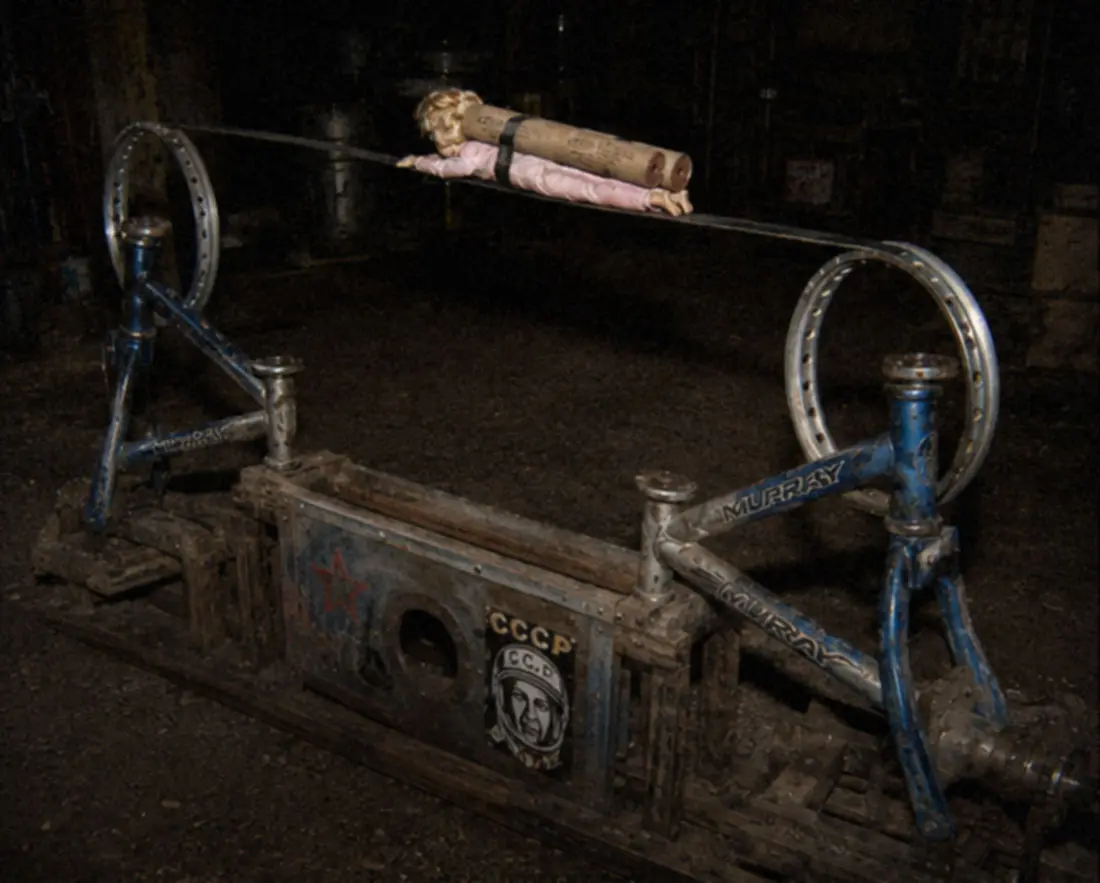
the childhood Murray bike rebuilt into a rocket-driven launch track
Don Krumpos · Fall 2006
The statement that hung in the sculpture shop, 2006:
My father is selling the farm I grew up on. He has been getting ready to for years, and now there is a buyer, so before the rest of it is hauled off or scrapped I am going through it and making work out of what is there.
The rig on the skids is a launch machine. Its frame is the Murray bike I got for my sixth birthday and rode until there was no more childhood to ride it through. I have made it into a track. Two solid fuel engines fire one after the other and send a cosmonaut around the loop, a Barbie off my eldest kid’s shelf, her hair cut short and singed, strapped to a rocket built of shipping tubes. The ignition key is the one my father taught me to press when I built model rockets as a boy. If you are here for the firing, stand back. It does not last long.
Some of this does nothing. The red star, the porthole, the name stenciled on the capsule. I have never been able to leave a surface plain, and I have stopped fighting it, because a machine dressed up past its purpose will usually tell you what it is really for.
I am not trying to keep the farm. You cannot keep a place. I am trying to take its matter, the bike and the bolts and the boy who rode it, and send it off as something that outlasts the ground it came from. The other machine I built from this farm was made to go all the way in and hear nothing. This one is made to go all the way out. It is one of several things I am making from the place before it goes.
Stand back. She only leaves once.
I got the bike for my sixth birthday. It was blue. By the time I was thirty-two it was rusty, the color gone chalky, the labels lifting at the corners, and it had carried me over the whole radius of a childhood, which on a farm is not a metaphor. It is a literal measurement of how far a boy can get and still be home for supper. You do not think of a bike as an object at that age. It is closer to a limb. I did not think of it as a thing I could take apart until I was in my thirties and about to lose the ground it had carried me across. When I finally did, it was not to junk it. I thought it a good tribute to send it off the right way.
By 2006 I was in art school, which meant that for the first time I had the three things I had spent my life short of all at once: time, real tools, and people who knew how to do what I only half knew how to do. And the farm was going, my dad getting ready to sell, so I went through the place the way you go through a house before a move, except I was not looking for what to keep. I was looking for what I could turn into something before it got hauled off. I had already pulled the old horse trough for one machine, a thing built to go nowhere, to hold a body still in salt and dark until the world went quiet. This one was its opposite, and I think I knew that while I was building it. If the trough was a machine for going all the way in, the bike would be a machine for going all the way out. Two ways off the same farm. One of them stops. One of them leaves.
The other thing I was reaching back for was the rockets. I had built model rockets in fourth and fifth grade with my dad’s help, and I wanted that technology back in my hands, wanted to tinker with it again as a grown man. The ignition kit I used was the actual one I still had from being a kid, the same little launch controller with the key and the wire. Everything else I had to buy new, engine after engine, most of them spent on trials that did not work before the one that did. There is something about firing the launch key your father first showed you how to use, in the year he is selling the farm, that I did not have words for then and only half have now. So I built the machine around it instead.
I did not build it alone. I came into the studio one afternoon and found Casey Early-Krueger hunched over the work in progress, walking slow circles around it with his curious grin. I told him what it was. He wanted in. Casey was a sculpture major, which I was not, and much further along in materials than I was, and he turned out to be a model rocketeer from childhood too, so the whole idea lit him up. He helped me rivet and cut, shaped cardboard shipping tubes into guides at the sections that needed them, and worked out with me the timing of two solid fuel engines staged one after the other, so the thing would drive itself around as long as we could make it last. That kind of clever engineering was in the water in that department. Somewhere in one of Davy’s lectures we had all met Rube Goldberg, and after that a certain contraption logic became a point of pride. David Damkoehler was the sculpture professor, Davy to us, and Norbert Cox was his helper, and most of us admired them the way you admire people who can actually make the thing you are only describing. Davy was also the one who made me keep the rig in the sculpture workshop, on account of the fire hazard, which in hindsight was the correct call.
The astronaut was a Barbie, and she came out of my eldest kid’s collection. I cut her hair and burned some of it off for effect, and strapped her face-down to the shipping-tube rockets so she rode the belt like she was flying it. I dressed the whole thing up past what it actually did, the way I always do, because I have never been able to leave a surface plain or build a machine that does one thing without making it look like it does ten. What it wanted to look like, it turned out, was Soviet. A red star. A porthole. A cosmonaut’s helmeted face and CCCP stenciled across the capsule. Not the clean American moonshot but the other one, the rougher one, welded up out of a farm bike and a child’s doll and a bundle of cardboard tubes. A cosmonaut is a good patron saint for a machine like this. The whole program ran on nerve and salvage and going up in the thing anyway.
We launched her during class, which gave me a built-in audience, padded out with the students who turned up from other lectures for the extra credit. As usual I had put up posters around campus that I designed myself, to pull in a few more. We crossed our fingers. We lit her up. She zipped around the loop six or seven times in a couple of seconds, and then it was over. Casey stood by with a fire extinguisher the whole time, just in case, though with Casey it was probably more for effect. He was as much about the performance as I was. This is a man who once built his own work into an effigy and burned it on the concrete of the student commons during the exhibition he had not been selected for, but that is another story.
The trough had failed its one job in front of a full room, and that was the best thing about it. This one did the opposite. It worked, exactly and completely, for about two seconds, and then it was done, which is the truest thing a machine for leaving could do. I had no room to store it after, so it went into the sculpture department’s scrap yard, back onto the pile of someday material, for a future student to cut apart and turn into something of their own. Which is the same pile, and the same window, I had built the whole thing out of. That is most of what I remember about being a boy on that bike too. The going, the brief noise of it, and how fast you are home again. I got the bike when I was six and I sent it off when I was thirty-two, the year before the farm went, and the one part of it that had already left home once and come back was the little ignition key my dad taught me to press.