The Ruins of the Midwest
A Machine for Sowing
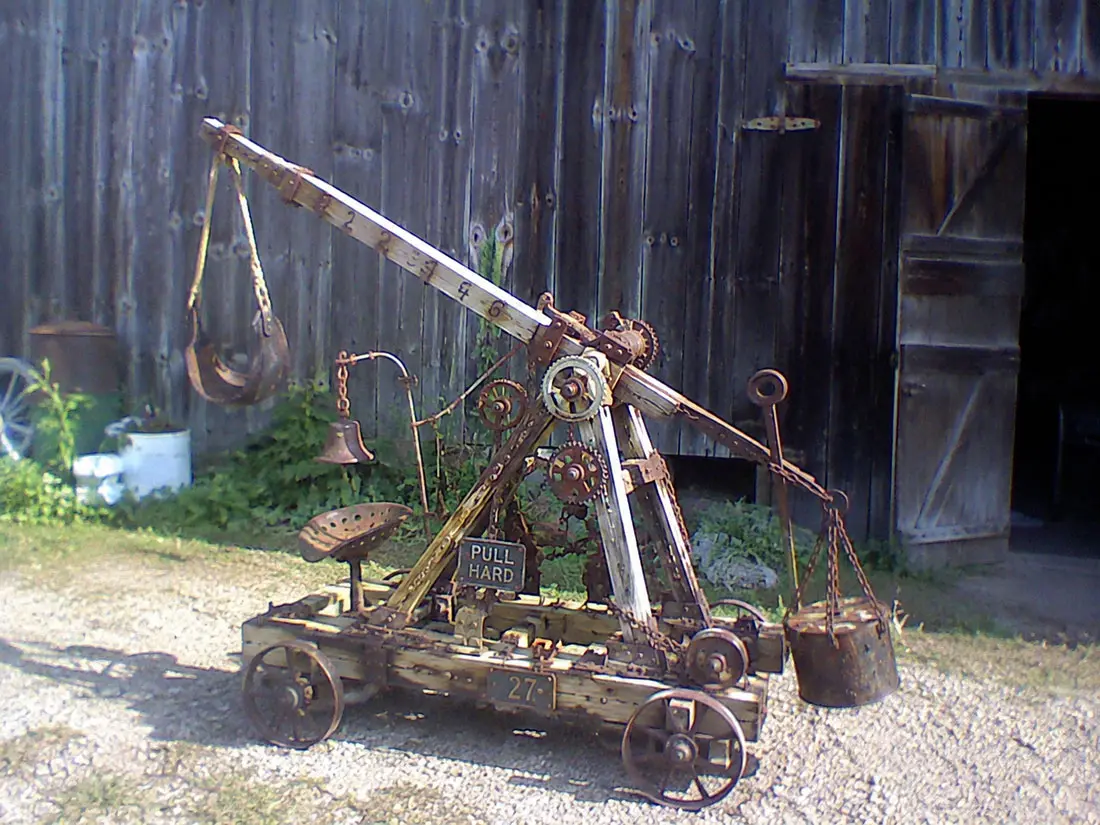
a trebuchet built from the burned harvest beast, worked by whoever showed up
Don Krumpos · Fall 2006
The statement that hung at the reception, 2006:
My father is selling the farm I grew up on. Before the rest of it is hauled off or scrapped I am going through it and making work out of what is there, faster than he can sell it.
This machine is a trebuchet, and it is built almost entirely out of one other machine. In the corner of our machine shed, sunk in the mud my whole childhood, there was an old thing my father called broken. A thresher, maybe, or a grain elevator. Cast iron on the inside, wood on the outside, painted red a long time ago, with words hand-lettered along one side. It took two men and a winch to drag it into the light this spring, and I saw all of it for the first time in my life on the day it came out. Then it was burned. What you see here is the parts of it I could carry off the fire, given an arm and a sling and a second life.
It used to be a machine for bringing a harvest in. I have made it into a machine for throwing seed back out.
Some of it does nothing. The pulleys, the extra gears, the board with the old paint. I have never been able to leave a surface plain, and I have stopped fighting it. Load a ball of clay and seed into the sling. Pull the pin. It will carry about a hundred feet into the meadow. You throw it. I have thrown enough of this place already.
I built four machines out of the farm the year my father sold it, and this was the largest of them. It was also the one made most completely out of the place, because almost every part of it had been a single object first, a machine I had been afraid of since I was a boy.
By 2006 I was in art school, which is to say that for the first time in my life I had time, real tools, and people who knew how to do the things I only half knew how to do, all at once. And the farm was going. My dad had been getting ready to sell for years, and now there was a buyer, so I went through the place the way you go through a house before a move, except I was not looking for what to keep. I was looking for what I could turn into something before it was hauled off. I was pulling material out of that farm faster than he could sell it or run it to the scrap yard, and most of what became this piece I took off the top of a fire.
There was a machine in the corner of our machine shed that had been there my entire childhood. It was mostly wood on the outside, sunk into the mud floor, and my dad said it was broken, that it needed parts we never got. We did not really do wheat on the hobby farm. He used the other old machinery that came with the place, and this one just sat in its corner in the dark, and I grew up a little afraid of it and unable to leave it alone. That corner of the shed was where I played, and the machine was the thing back there in the dark that the playing was always half about, an old beast, broken, hiding, waiting out the decades. I could tell you more about that machine than about most people I have known. A child gives a shape like that a whole inner life.
When my dad started clearing the farm to sell it, the beast had to come out, and it did not want to. It took my two uncles and a truck with a winch to drag it slowly out of the mud it had settled into, and I stood there and watched it come into the daylight, and that was the first time in my life I saw the whole of it at once. It was magnificent. Cast iron on the inside, a wooden body, red paint gone to almost nothing, a conveyor along the top, and words hand-lettered down one side in the fat serif type of another century. A thresher, I had always thought. Seeing it whole I decided it might have been an elevator, a machine for lifting grain. Either way it was a harvest machine, a thing built to bring a crop in off a field, and it had spent my whole life not doing that, just sitting in the corner being enormous and broken.
I wanted the whole thing. There was no version of my life at that moment with anywhere to put it, so my dad burned it in the driveway, and I stood at the fire and pulled off it what I could carry. I took the arm. I took iron. I took the board with the painted words. And because I had it in my hands and it had to be used right away or lost, it turned into the next machine almost without my deciding, which is how the best of these went. I had been telling Casey Early-Krueger for a while that I wanted to build a trebuchet, and Casey being Casey had already started rattling off how, and now I had the material, still warm, and a reason to build it that week.
I put it together in the back of the sculpture studio. The engineering of a trebuchet is not actually hard, which is a humbling thing to learn about a machine that has always looked to me like it required a wizard, but in 2006 there was nothing useful online and nothing much in the library either, so I worked it out from a few photographs and a lot of guessing. We could roll it out the big garage door for a quick test in the lot behind the building, throw something, and roll it back in before anyone official came around. That we did not have permission to be building or throwing anything was understood between us and never discussed. UW-Green Bay sits in the middle of old farm fields and an arboretum, so we were never short of a field, and asking the campus would have meant red tape and a no we could already hear, so we did not ask. Half of what I made that year was made by not asking.
I dressed it up past what it did, of course. Pulleys it did not need, gears that turned nothing, the old painted board mounted where you would see it. I have never been able to build a machine that does one thing without making it look like it does ten, and I have made my peace with that, because a machine costumed past its function usually tells you what it was really for. What this one was really for was not distance. It was the throwing.
When it was time for the real test it took five strong friends to get it into a truck and out to a field where no one would see, and out there we threw the usual things a trebuchet is for, pumpkins, potatoes, whatever was heavy and would burst. But that was rehearsal. For the opening reception I had made the ammunition on purpose. Clay balls about a foot across, each one packed with seed, made to fly a hundred feet out into the meadow and break open where they landed. And I did not throw them. The people who came threw them. You loaded the sling, you pulled the pin, and you sent a ball of seed and clay arcing out over grass that had been farm field not long before, and it came down and split, and that was the piece. A harvest machine, rebuilt into a machine that sows, worked by whoever showed up, throwing the farm back out into the world a fistful at a time.
I have thought since about what it means that the other going-out machine I built that year, the launch rig, sent one thing off one time. A single cosmonaut, one loop, two seconds, gone. This one did the opposite kind of leaving. It threw many, it threw over and over, it threw seed instead of a passenger, and it put the throwing in other people’s hands. If the rig was about escape, one body getting off the place for good, this was about dispersal, the place itself coming apart on purpose and going everywhere at once. You cannot keep a farm. But you can take its oldest broken machine, the one you were afraid of as a child, and make it fling the place out across a meadow as seed, and let a crowd of near-strangers do the sowing.
Afterward there was nowhere to keep it, the same as always, so some friends helped me drag it into the hedgerow at the edge of the field and I left it there to rot. That is where it is, as far as I know, gone soft and green by now if it is anything at all. The launch rig went onto the scrap pile it had been built from. The still is still dug into its ravine. This one I gave back to a hedgerow, which is the one ending of the four that I do not regret, because a hedgerow is where a farm keeps its wild edges, and a machine that threw seed for a living, however short a living, belongs in the seed bank at the margin of a field more than it ever belonged in the dark corner of a shed. I wish I had kept the board with the painted words. I wish I had kept all of it. But the machine did the one thing I built it to do, which was to take the farm apart and throw it somewhere it might come up again, and then it lay down in the brush and started doing that itself.